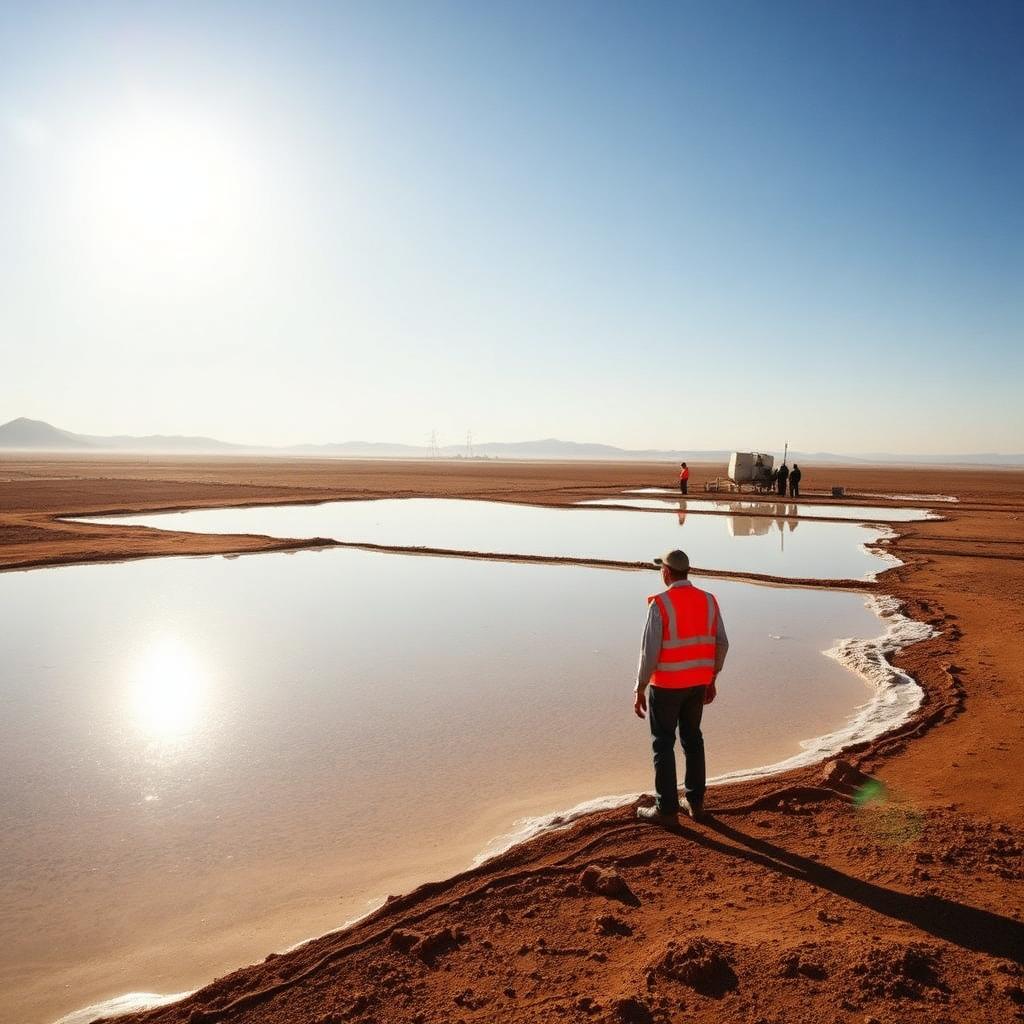
ARUSHA — Tanzania’s Mining Commission has awarded a two-year exploration permit covering 340 square kilometres of alkaline flats south of Lake Natron to Rift Lithium Ltd., a joint venture between an Australian junior and an Abu Dhabi-based commodities house. The award, gazetted on 3 July, marks the first serious step toward commercial lithium extraction anywhere in East Africa.
The permit area sits within the northern arm of the Gregory Rift, a geological province where earlier surveys by the Geological Survey of Tanzania flagged unusually high lithium concentrations in shallow brine aquifers. Rift Lithium’s programme calls for eighteen wells to be drilled in the first twelve months, with an initial resource estimate expected by the third quarter of 2027.
“What we are testing is whether the concentrations we see in the surface waters extend into the deeper aquifers, and at what flow rates,” said the company’s exploration manager, Dr. Peter Klose, in a briefing to reporters in Arusha. He declined to disclose the target grade but confirmed that direct-lithium-extraction technology, rather than conventional evaporation ponds, is being evaluated as the preferred production route.
The permit has drawn immediate scrutiny from environmental groups. Lake Natron is a designated Ramsar wetland and the near-exclusive breeding site for East Africa’s lesser flamingo population, some 2.5 million birds. In a statement, the Wildlife Conservation Society of Tanzania called on the Commission to require a full strategic environmental assessment before any production licence is contemplated, noting that even modest changes to the lake’s hydrology could disrupt breeding cycles.
The Mining Commission’s executive secretary, Prof. Idris Kikula, said the exploration phase itself carries no extraction rights and that a separate, more rigorous approval process would apply before any commercial development. “The permit is a licence to look, not a licence to take,” he said.
For Tanzania, the strategic prize is considerable. Global lithium prices have recovered sharply from their 2024 trough, and battery manufacturers in China, Korea and increasingly the Gulf are scrambling to secure supply outside of the established Chile-Australia axis. A viable East African source, close to the Dar es Salaam port and to the Standard Gauge Railway, would command a premium.
Whether that prize can be captured without irreversible cost to one of the continent’s most fragile ecosystems is the question that will shape the next twenty-four months.